
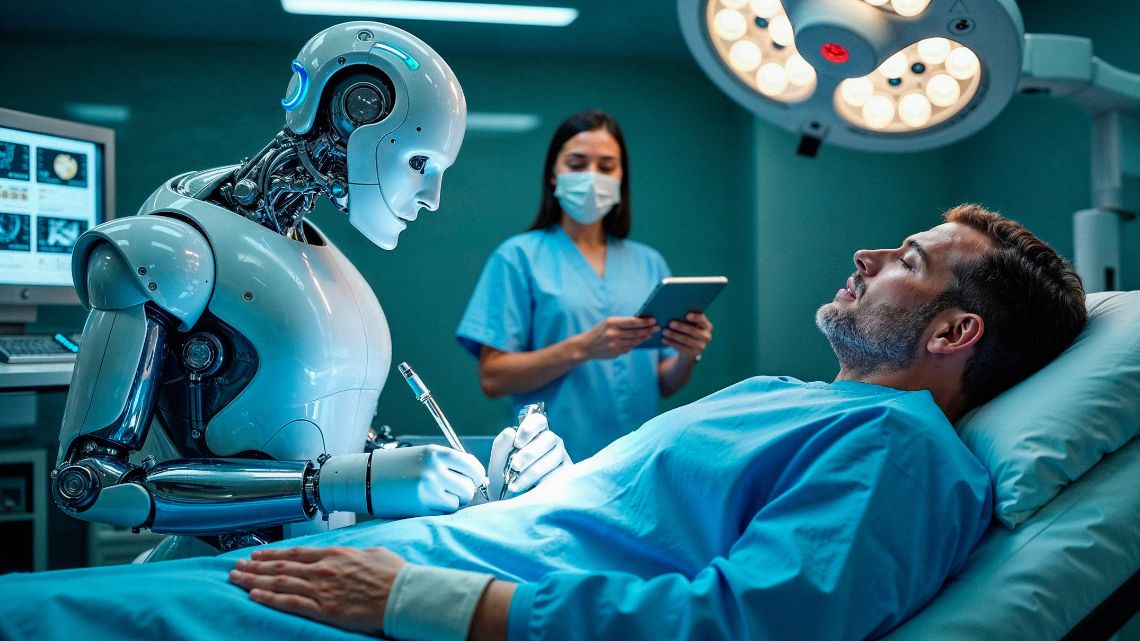
Dr. Farida arrives at Cleveland General Hospital after a ten-hour flight and a three-hour layover. Jet-lagged and famished, she pushes herself to attend to her patients first. She checks the morning labs, greets the nurses on rotation, and signs off on her notes. Meanwhile, an AI assistant on her tablet runs overnight scans for irregularities. Suddenly, the AI tool flags a subtle lesion on a CT scan that the clinicians initially missed. Upon reviewing the flagged image, Dr. Farida combines it with the patient’s history and determines the next course of action. Later in the day, she assembles the clinicians and trains them to interpret the AI output and how to go about handling sensitive patient conversations—the human parts the machine cannot do.
Although this is just a small part of every professional’s day in the healthcare sector, Dr. Ameena’s morning shows how the future will look across the globe: doctors, nurses, and technology working together toward a shared purpose. Over the last few years, automation has taken over many repetitive human tasks. And with the rise of artificial intelligence in the healthcare system, however, many people fear a total takeover that could displace the human workforce.
The truth is that AI will continue to grow in efficiency, but it will also create new job opportunities requiring people to build advanced skills, manage AI systems, and humanize their use across a reliable, smooth continuity of care (CoC).
Automation is Not the Bad Guy
The primary narrative that’s going around is that people still fear mass layoffs. But reality and statistics say differently. According to the World Economic Forum, new technologies and the green transition will create 69 million net new jobs globally in the next five years, even as other jobs shift or disappear. PwC’s 2025 Global AI Jobs Barometer reinforces this view, finding that AI can actually make people more valuable and drive demand for new hybrid roles that blend both technical and human skills.
For EMEA’s healthcare systems, this means growth in roles such as digital health consultants, data administrators, clinical-AI specialists, and hybrid clinician-engineers. These jobs need humans who understand medicine as well as technology. Because at the end of the day, AI can only assist while people must lead.
Where AI Adds the Most Value in Clinical Care
The European health authorities highlight a rather simple belief: AI can improve the use of resources, predict admissions, and categorize patients according to priority. This frees up clinicians, allowing them to focus on the more complex, empathy-driven tasks. According to the European Commission’s Public Health, AI can now optimize hospital beds, staff, and equipment to reduce waste and improve care. In Africa and the Middle East, pilots pair remote diagnostics with local clinicians to extend reach in disadvantaged regions; in Europe, radiology and pathology are two departments embracing AI to speed up interpretations.
The Human-in-the-Loop Formula
It is imperative today for health leaders across the EMEA to adopt a “human-in-the-loop” approach. In this model, management will need to design workflows where AI proposes, humans decide, and the team learns. But that requires three changes:
- Investing in Hybrid Skills – Health leaders must train clinicians in data fluency and give engineers much-needed clinical exposure. With automation creating new roles, the human workforce must continuously upskill and retrain to supply the talent pipeline.
- Prioritizing Data Reliability and Integration – AI depends on clean, complete, and connected records. And so, managers should make data engineering a strategic capability and form partnerships with regional health networks.
- Building Trust Through the System – The World Health Organization (WHO) urges ethical governance for AI in healthcare so that systems can benefit the people equally and safely.
What Health Leaders Should Now Watch Out For
Health leaders must now ensure that hospitals start their human-AI collaboration with low-risk, strategic initiatives: smart bed management, diagnostic imaging, and virtual healthcare. This reduces mental and physical exhaustion, freeing clinicians to focus on patient-centered work in community outreach, counselling, and complex decision-making. As managers document results, they will create internal success stories that justify scaling and hiring recruits.
But what are the measureables? Leaders must measure time saved on administrative tasks, diagnostic accuracy, patient satisfaction, and job transitions (who moves from Administrations into Data/AI roles). Using these metrics to design incentives for clinicians to reskill, managers must be certain that automation leads only to reallocation and not unemployment.
Smarter Tech, Stronger Teams, and Better Care
Rules will shape the pace, and implementation will drive the outcome. According to the EU’s AI Act, launched on 1st August 2024, the policy will influence standards, certification programs, and market trust across European healthcare providers. This shift will also set a regional precedent for a more responsible use of AI in healthcare. Managers in the EMEA must now align their AI adoption plans with future laws so their healthcare organizations remain compliant as they introduce new AI tools.
The main point is that automation will surely restructure work in healthcare systems, but it will not replace the human heart in providing care to patients. Leaders who invest in retraining and data literacy, plan for hybrid roles, and build a culture of integrity across all levels will unlock new job opportunities and better patient outcomes. In Dr. Farida’s context, the machine flags the anomaly, but she brings the judgment, empathy, and conversation that make healing possible. That blend of machine speed and human care is the future that managers must shape, starting today.
To read more, visit EMEA Entrepreneur.