
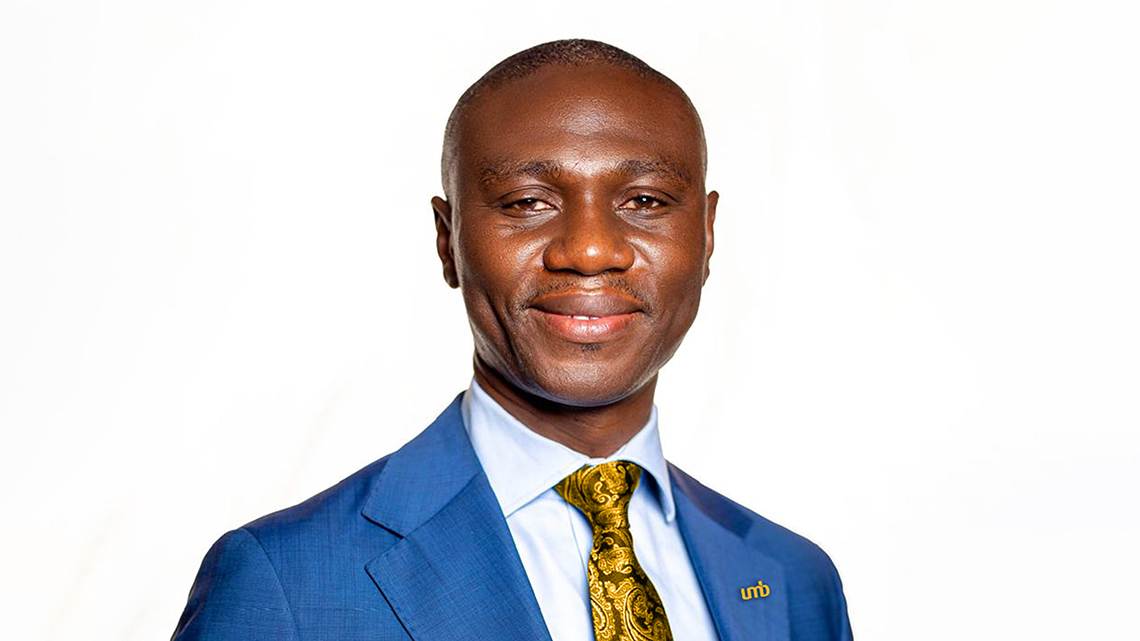
Dr. Philip Oti-Mensah, CEO, Universal Merchant Bank
Endurance in entrepreneurship is forged in moments that never make headlines, small decisions taken with incomplete information and lived with long after the choice is made. Progress depends less on conviction than on the ability to remain steady when clarity eludes you. Over time, these unremarkable moments accumulate, shaping outcomes that later appear intentional. What looks deliberate in hindsight is often the product of restraint, judgment applied early, upheld privately, and repeated long after the moment has passed. This understanding informs the leadership approach of Dr. Philip Oti-Mensah, CEO of Universal Merchant Bank, where judgment is viewed as a long game rather than a series of headline moments. His work reflects a belief that institutions reveal their character not in expansion, but in how they hold together under pressure.
Dr. Oti-Mensah’s professional journey has been shaped almost entirely within financial services, spanning corporate banking, risk management, credit administration, restructuring, and executive leadership. This range has cultivated a practical understanding of banking as a system of interdependencies, where trust precedes performance and clarity must be maintained even when certainty is unavailable. Leadership, in his view, is stewardship, balancing ambition with prudence while resisting the quiet erosion caused by fragmented decisions. As he shares, “I try to leave systems steadier than I found them.”
At Universal Merchant Bank, that philosophy translates into disciplined execution, clear accountability, and a patient rebuilding of confidence. The emphasis is on reliability and alignment, so performance becomes predictable and trust compounds over time.
Immediate Priorities Upon Assuming Office
What appears deliberate in hindsight is often shaped by restraint at the outset, by choosing to listen before choosing to lead. This instinct guided Dr. Oti-Mensah as he assumed office as CEO of Universal Merchant Bank. Rather than rushing to impose change, he focused first on understanding the institution as it was experienced by those closest to it: staff, customers, and regulators. Diagnosis, he believed, had to precede direction.
From that process, three priorities emerged. The first was stability and operational discipline. In banking, confidence is built through consistency, through predictable, reliable experiences in routine interactions that often go unnoticed until they fail. The second was asset quality and balance sheet strength, reinforced through closer credit monitoring, recoveries, and risk governance, not only to protect capital but to enable responsible lending. The third was internal alignment and culture. Performance, in his view, is a consequence of clarity; when expectations are understood, organizations regain composure. “Momentum follows order, not the other way around,” he observes. These priorities were foundational by design. Growth, after all, is only meaningful when built on stability that can endure.
Digital Transformation & Customer Experience
Trust is built by how reliably it performs when no one is watching. That conviction shapes how Dr. Oti-Mensah approaches digital transformation: not as an arms race of features, but as a commitment to availability, consistency, and access. For customers, sophistication matters far less than the quiet assurance that the bank will work, every time.
At Universal Merchant Bank, technology supports growth in two practical ways. First, it extends reach beyond physical branches, enabling individuals, traders, and small businesses to engage with the bank on terms that suit their daily realities. Second, it strengthens service quality. Automation reduces wait times, limits errors, and introduces predictability into routine transactions, payments that clear, confirmations that arrive, and systems that hold. As he remarks, “A system earns trust when it behaves the same on a good day and a difficult one.”
The focus has therefore remained on reinforcing core platforms, improving transaction success rates, and integrating customer touchpoints, rather than multiplying applications. In this approach, digital progress aligns with the bank’s broader purpose: delivering dependable, ethical, and diligent service, at speed, but never at the cost of confidence.
UMB’s Role in National Development
National development is built through sustained support for productive enterprise, in compounding ways that only later appear deliberate. That belief underpins how Dr. Oti-Mensah understands the bank’s place in Ghana’s economic story: as a long-term institutional partner to growth. Established in 1972 as Merchant Bank Ghana, UMB was founded with a clear mandate to support local enterprise, facilitate trade, and strengthen the foundations of private-sector development. More than five decades on, that purpose remains intact. As an indigenous bank, UMB operates with an embedded understanding of the realities within developing economies, recognising that many Ghanaian businesses, despite their central role in employment and trade, do not fit into standardised global credit models. This context has shaped a bespoke approach to financing, grounded in operational realities rather than abstractions.
UMB’s developmental role has been formative. The bank pioneered hire purchase and leasing in Ghana, enabling asset acquisition at a time of limited financing options, and catalysing growth across commerce, transport, and light industry. It promoted and helped establish Ghana’s first Discount House, contributing to money market development, and initiated foundational work that led to the creation of the Ghana Stock Exchange, later sponsoring and registering nearly half of its early listings. UMB also structured and established HFC Bank and advised on landmark transactions such as the SSB–Société Générale acquisition and the Ashanti Goldfields–AngloGold merger.
Today, UMB supports enterprises across commerce, SMEs, local supply chains, and key productive sectors through working capital, trade finance, and advisory services. Often, the role extends beyond lending, helping businesses structure transactions, manage cash flows, and navigate uncertainty. “Development shows up after the cheque is written,” he notes. For UMB, balancing commercial discipline with developmental intent is not a slogan, but a mandate, one carried forward as Ghana’s economy continues to evolve.
The Work That Outlives the Moment
For Dr. Oti-Mensah leadership has never ended at the edge of the institution. Community engagement, as he understands it, is not philanthropy by another name but an extension of responsibility, one shaped by daily exposure to how financial decisions ripple through households, businesses, and informal markets. His emphasis on financial literacy, education, and support for entrepreneurs reflects a conviction that access without understanding can unsteady lives, while knowledge creates independence that compounds quietly.
This grounding informs how he views the future of banking in Ghana and across Africa. Competition is intensifying through fintechs and mobile platforms. Expectations are sharpening around speed, transparency, and simplicity. Inclusion remains unfinished work in economies where informality is the norm. Yet amid these shifts, his focus remains fixed on fundamentals: reliability, prudent risk judgment, and trust sustained over time. “Progress only matters if people can stand on it,” as he states.
At Universal Merchant Bank, these beliefs translate into disciplined choices, strengthening foundations, investing deliberately in technology, and staying close to customers rather than trends. The bank’s long history of innovation and recognition is not treated as a victory lap, but as a responsibility to hold steady. In the end, the measure of leadership is what still works when attention moves on.