
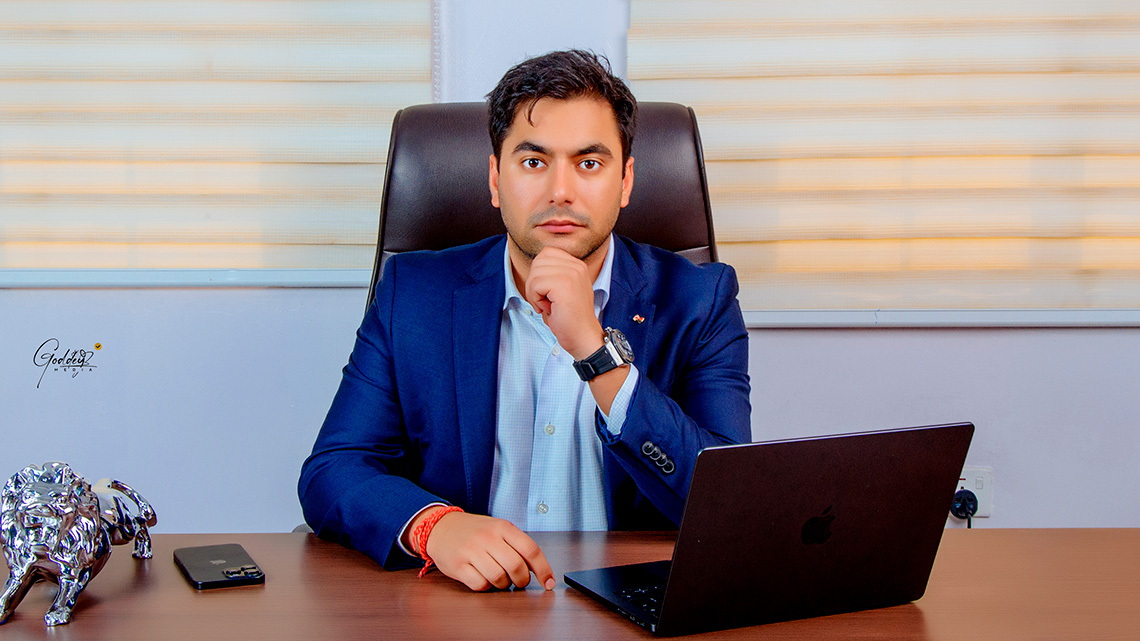
Akshay Daswani, Executive Director, The Papilon Company Limited & Leao Viva LDA
In the high-stakes world of West African industry, manufacturing is rarely just about production lines and profit margins; it is a ‘personal relationship’ forged through decades of grit and adaptability. It is a demanding environment where the ability to innovate determines whether a legacy thrives or simply fades away.
Akshay Daswani, the Executive Director of The Papilon Company Ltd in Nigeria and Leao Viva Limitada in Angola, embodies this spirit of evolution. Representing the third generation of his family’s industrial journey, Akshay is blending a traditional work ethic with a modern, systems-driven approach to redefine what it means to be an industrialist in the 21st century. When he boarded the first flight back to Lagos after travel restrictions were lifted in 2020, he wasn’t just returning home; he was stepping into the weight of a legacy that began nearly sixty years ago.
A Legacy Rooted in History and Home
The story of this industrial powerhouse began in 1965, when Akshay’s grandfather arrived in Nigeria as a trader. Growing up in this environment, Akshay was a firsthand witness to the sheer tenacity required to succeed. He recalls watching his father and grandfather working late into the night at their home office, long after the factory gates had closed—a visual that defined his own understanding of dedication. For the Daswani family, the business was never just a job; it was a constant, breathing presence in their lives.
While his family’s roots trace back to India, Akshay’s identity is firmly anchored in the continent where he was raised. He speaks with a clarity that reflects deep belonging, identifying himself by his commitment to his home country: “I am Nigerian, and my passport is green.” This sense of belonging is the engine behind his long-term vision, ensuring that his business isn’t just an entity operating in Africa, but an integral part of its economic fabric.
The Global Forge: Discipline and Systems
Akshay’s path to leadership was refined by a global education that provided him with a unique blend of personal discipline and strategic vision. At the age of 13, he was sent to boarding school in the United Kingdom, an experience that he credits with instilling in him a permanent sense of discipline. From the simple act of shaving daily to the importance of professional presentation and showing up neat for every meeting, these early habits became the foundation of his leadership style.
Later, at the University of Texas, he studied entrepreneurship, which equipped him with the strategic mindset to modernize the family’s operations. He returned to West Africa identifying as a ‘systems and process guy’. He recognized that while his predecessors had built the business on grit and informal market intuition, the future required precision. Upon joining the business, he oversaw the transition from the former group name, Leoplast, into two specialized, independent entities: The Papilon Company Ltd and Leao Viva Limitada. This shift was designed to improve internal management and allow for greater focus in the Nigerian and Angolan markets.
Modernizing a Giant: Systems and Innovation
As the architect of this new era, Akshay’s first major task was to drag the operation into the digital age. He moved the company away from antiquated, pen-and-paper documentation to fully online systems, implementing rigorous ISO standards and Standard Operating Procedures (SOPs). To Akshay, these systems are not for decoration; they are the essential infrastructure that allows a business to scale and maintain consistency across different countries.
He also recognized that for the company to stay relevant, it needed a ‘digital heartbeat’. Under his direction, the business built one of the strongest social media presences in the industry, a move that increased visibility and helped transition the company toward corporate packaging. This visibility was a catalyst for major growth, leading to partnerships with global giants like Perfetti Van Melle (the makers of Mentos) and entry into the pharmaceutical packaging sector.
However, his leadership was most significantly tested by the shifting regulatory landscape. When Nigeria implemented a ban on single-use plastics in 2023, Akshay did not see it as a roadblock, but as a directive to innovate. He successfully pivoted the company’s production from traditional thermofoam to thin-wall packaging, a move that ensured the business remained ahead of the curve while providing more sustainable solutions for the market. His mantra is simple but profound: “If we’re not innovating, we’re dying.”
Leadership Through Culture and Wellbeing
Managing multicultural teams of over 100 expatriates and local staff across Nigeria, Angola, and Myanmar, Akshay emphasizes a ‘family-type culture’ rooted in mutual respect. His workforce is a mosaic of nationalities—including professionals from the Philippines, South Africa, and India—representing a variety of faiths. For Akshay, leadership is about being strictly unbiased and performance-based. He famously traveled between Nigeria and Angola in a single week to celebrate Diwali with his teams in both countries, demonstrating a personal commitment to the diverse cultures that drive his business.
Crucial to his effectiveness is his commitment to mental and physical health. His day begins with a non-negotiable 15-minute meditation, followed by a fitness routine. He also makes a conscious effort to stay off his phone for the first 45 minutes of the day to avoid the ‘chatter’ of the digital world, ensuring he starts his work with a clear intention. “If I’m not able to even take care of myself, then how am I going to take care of others?” he asks. This focus on wellbeing has even transformed his relationship with his father; the two now train together four times a week, a practice that has significantly boosted their shared productivity and strengthened their personal bond.
The Road Ahead: Building Something Bigger
Currently, Akshay oversees global procurement, ensuring that his factories have the materials and machinery they need to compete on a world stage. However, his long-term vision is to evolve the group into a self-sustaining entity where perfected systems allow him to move from daily factory management to a more investment-focused role. He wants to explore new verticals and find innovative ways to serve the African market, ensuring the legacy he inherited continues to grow for future generations.
His advice to the next generation of entrepreneurs is simple yet profound: be selfless. In an industry fraught with logistical risks and economic shifts, he finds deep satisfaction in seeing his machines running and knowing he is providing essential solutions for millions. For Akshay Daswani, manufacturing is about more than just plastic; it is about building ‘something bigger than himself’.