
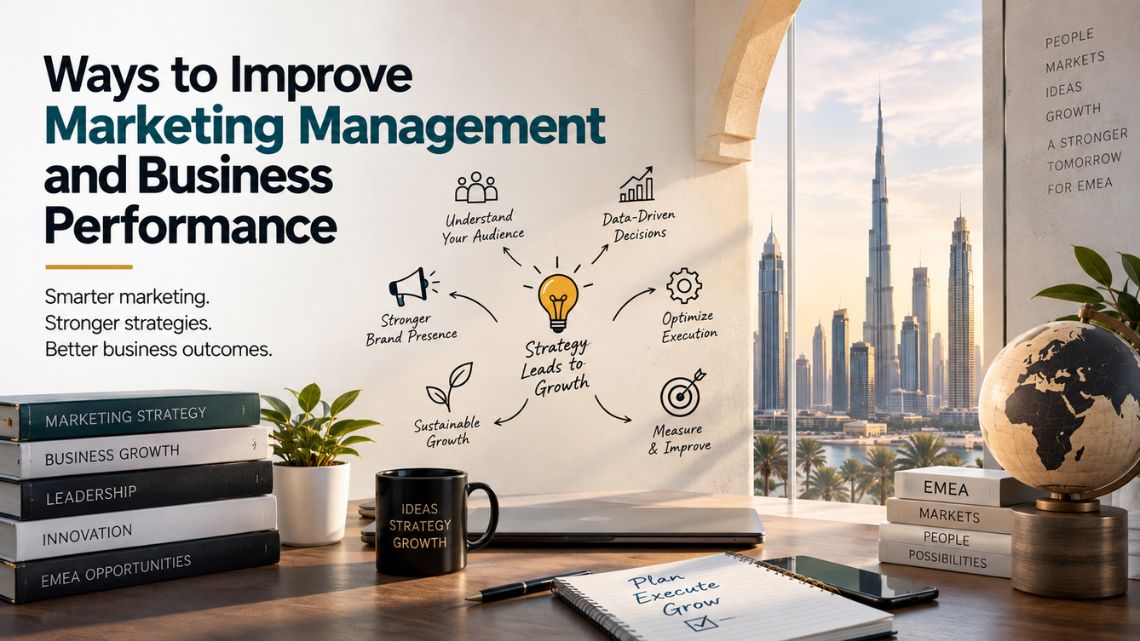
Improving marketing management and business performance requires a strategic discipline of aligned planning, coordination, execution and analytics based iteration. It is integral for positioning an organization within its target markets as well as mitigating unforeseen challenges. Marketing goes beyond the execution of campaigns, lead generation or maintaining a positive digital presence. More importantly, it refers to aligning product-market fit, distribution, pricing and brand image for the long term business sustainability. At an enterprise level, it directly impacts a company’s profitability potential, CLV, operational efficiency, long-term market positioning and value.
For businesses in the EMEA, the diverse regulatory frameworks, economic conditions, digital maturity levels, and purchasing behaviors makes brand management an indispensable corporate priority. The currency to improve business performance and marketing is enhancing customer lifetime value, building market specific responsiveness and maintaining strategic consistency toward sustainability rather than focusing on transactional values.
What Are the Key Ways to Improve Marketing Management and Business Performance?
The EMEA Entrepreneur outlines several key priorities for marketing management which produce positive business outcomes.
- Align marketing with business strategy
The marketing strategy must be in alignment with business strategy. Marketing goals should support the business objectives of the organization such as retaining existing customers, generating revenue, profitability, and achieving exponential business growth. This ensures that marketing operates as a contributor rather than as merely a support function to the business.
- Strengthen customer and market intelligence
Market knowledge and customer intelligence must be enhanced with centralized data engines, real time analytics, and research. The availability of accurate data intelligence allows business leaders to comprehend customer behavior, competitive environment, market changes, and changing demands and integrate it to adjust strategic changes. The leverage of market research, first-party data, customer feedback, and business data assets strengthens decision-making and identifies opportunities for establishing early growth momentum.
- Improve segmentation and targeting
Broad definitions of the market often do not help to identify qualified prospects and purchasing capacities. Organizations can develop more precise targeting by evaluating the size of the organization, and the industry, strategic needs, high-potential account, and the profitability rates.
- Build clearer brand positioning
Establishing effective positioning gives the business the understanding of its own relevance, as well as the ways to differentiate itself within the market. Companies must create a united value proposition while localizing their messages in accordance with the target customers’ expectations.
- Integrate marketing, sales, and customer operations
Lack of coordination among departments usually creates significant tensions in terms of the commercial performance and business outcomes. Establishing effective positioning gives the business the understanding of its own relevance, as well as the ways to differentiate itself within the market. Companies must create a united value proposition while localizing their messages in accordance with the target customers’ expectations. This helps organizations decrease failure in cultivating revenue and improve conversion rates.
- Use data and technology more effectively
The integration of avenues such as CRM, advanced analytics, automation, artificial intelligence, and customer data systems, can lead to improved forecasts and cultivate enhanced personalization, productivity, and decision-making intelligence. Nevertheless, technology must serve as a supportive engine rather a replacement to executive judgment.
- Improve marketing resource allocation
The evaluation of a marketing investment should be based on its strategic and commercial impact rather than merely on the amount of the investment. The performance of the channels, campaigns, customer segmentation, and content can be optimized through value based budgeting.
- Strengthen performance measurement
Marketing branding should involve the use of sophisticated performance measurement frameworks combining marketing initiatives with business results. Organizations should track their qualified pipeline, the number of conversions, revenues generated, customer lifetime value, level of brand equity, and document post campaign learnings.
- Personalize customer engagement
The B2B buyers are more inclined toward brands executing contextualized communication—based on their previous purchases and customer journey experience. When used responsibly, customer intelligence can help organizations create personalized content, communication, offers, and experiences.
- Continuously optimize marketing strategies
Companies should keep adapting to technology evolutions, changing customer expectations, new trends in the market, and turbulent economic conditions by means of constant improvement of marketing strategy and establishment of effective operational loops, which support testing ideas and making informed decisions.
Conclusion
There is more to improving marketing management than merely ramping up marketing campaigns. An integrated approach is needed that connects corporate strategy, market intelligence, segmentation, positioning, technological resources, review and evaluation, and client engagement for cultivating better marketing and performance improvements. The crucial priority in the EMEA is to reflect corporate strategies with market needs and the establishing the ability to timely respond to them. By integrating marketing in business management as an instrumental business disciple, companies can improve operational efficiency, revenue generation, and growth.
To read more, visit EMEA Entrepreneur.
FAQ
How does marketing management improve business performance?
Marketing management links market intelligence and customer engagement with the strategic objectives of an organization, hence allowing for improved performance in revenue generation, customer acquisition, retention, efficiency, and competitiveness.
What Challenges Can Prevent Effective Marketing Management Across EMEA?
The following obstacles may impede the operational efficiency of an organization: market heterogeneity, complicated regulatory landscape, data silos, outdated IT infrastructure, poor interdepartmental communication, unstable customer intelligence.
What Is the Future of Marketing Management and Business Performance in EMEA?
In future, marketing management strategies will transform to a more data-oriented, predictive, automated, and AI-powered operating mode that involves the integration of customer intelligence and technology into business strategy.
To read more, visit EMEA Entrepreneur.