
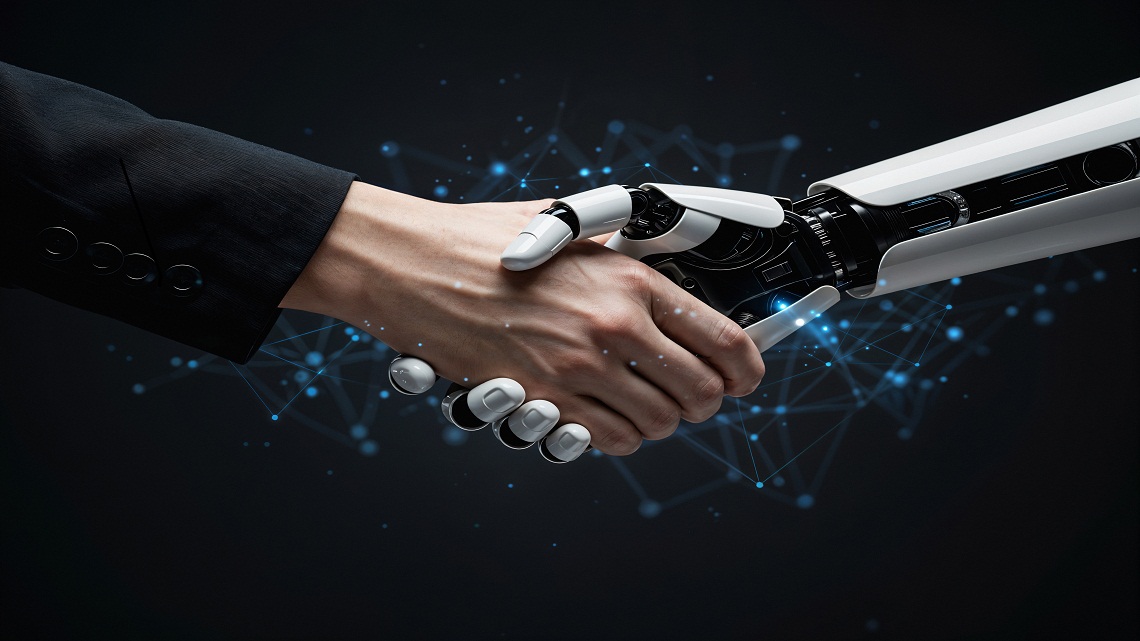
AI in this ever-evolving business era has transitioned from an automation tool to serving as a cognitive assistant in simplifying decision complexity. True organizational transformation does not lie in how an enterprise integrates AI or how well it performs autonomously, but in how efficiently we collaborate with it. With the continued implementation of generative and agentic AI systems across companies, collaborative intelligence capabilities between humans and AI will become a strong competitive edge as they are capable of contextually adjusting their methods of planning, innovating, and competing in an increasingly intelligent business environment.
What is Human-AI Collaboration Really Mean
Human-AI collaborations (HAIC) signify a systematic method of working model, where human and AI contributions integrate harmoniously by combining cognitive intelligence for creativity, judgment, and empathy and AI for improved data and analytical efficiency. By implementing this, organizations can achieve a structured framework without compromising cognitive or operational effectiveness, as both create synergistic strengths.
Unlike traditional Ai usage, adopting a human-AI partnership model presents numerous advantages. Primarily it operates as a partner-like component—autonomously planning, taking initiatives, and adapting without a rule-based input. While the major aim of conventional AI integrations was to automate repetitive human tasks, HAIC model focuses on augmentation. It is bidirectional and therefore ensures better efficiency, accuracy, compliance, and trust through expandability.
Key Characteristics of Human Ai collaboration are:
- Complementarity
- Continuous Learning
- Bidirectional Interaction
- Goal Alignment
The Current State of Human-AI Collaboration
Real world enterprise applications
- Marketing & sales
AI has changed how organizations gain insights into and interact with customers in the domain of marketing and sales. Collaborative AI systems provide customer behavioral analysis, the ability to create personalized content, assessment of buyer intent, and real-time improvement of campaign strategies.
AI is being used more frequently by sales teams in their roles as copilots for both lead prioritization and development of outreach messaging, as well as in simulating various deal scenarios. The role of the human in these instances has shifted from executing manual tasks to strategic orchestration and management of customer relationships.
- Operations
AI and human combined collaborations drive efficiency and resilience in operations by creating demand forecasts, optimally utilizing supply chains, detecting operational risk, and recommending actions to rectify issues.
Humans as operators provide expertise in specific industry verticals as well as verify and approve AI-generated decisions, helping to manage exceptions that require contextual awareness. In such a manner, the strengths of humans and AI are building adaptive systems that can respond to rapid changes or volatility at a large scale.
- Product & design
AI will assist with ideation and prototyping in product development and user experience design. Designers are using generative AI to examine numerous ideas, simulate their user behavior, and validate design assumptions significantly faster.
AI does not replace human creativity and intelligence, but rather it enhances the definition of what can be created by broadening creative avenues and allowing human teams to concentrate on developing strategic aims and innovative solutions.
Limitations of current systems
- Conventional AI systems are more reactive and often struggle with understanding intent and cultural and strategic implications.
- Black box models present trust and reliability hurdles due to opacity, lack of interpretability, and bias.
- Overdependence on AI system alone will create risks of compliance, strategic blind spots, accountability gaps, etc.
What’s Next: Key Trends Shaping the Future
The future of Human-AI Collaboration is quietly moving away from an automation-focused strategy to intelligent synergy. The four major trends that shape these changes are,
- Human-in-the-Loop Systems
Enterprise AI will be built on Human in the Loop Systems rather than being fully automated. This facilitates high-impact decision flows, as human oversight helps make better and unbiased choices. Bidirectional artificial intelligence system facilitates recommendations, simulates possible risk scenarios, and flags problems, while humans remain as an authority for intelligent evaluation and execution verification. This approach guarantees accountability, ensures that ethical standards are maintained, reinforcing strategic alignment in a rapidly changing business environment.
- Cognitive Augmentation
Cognitive Augmentation will shift from productivity tools to intelligence amplifiers with the increased availability of AI assistance such as agentic AI to help leaders process large amounts of information, identify hidden patterns, reduce biases when making decisions, and forecast future scenarios. The value of AI will transition from increasing the efficiency of tasks to assisting leaders in making strategic sense of their choices.
- Explainable & Trustworthy AI
Both explainable and trustworthy AI inventions are indispensable for successfully operating in highly volatile markets. As AI turns into an integral part across organizations, there will be requirements for systems that demonstrate how it has arrived at the particular outputs or decisions by revealing operational transparency, logic, and clarity in legally and ethically acceptable boundaries. The level of trustworthiness will determine the rate of adoption in the future.
- Multimodal Collaboration
Multimodal Collaborations will facilitate a more natural human and AI collaboration manner as they merge text, voice, visual representations, and live contexts simultaneously. AI will be able to use these modalities to effectively collaborate in multiple cognitive channels, therefore making it seamless, intuitive, and more immersive, beyond what traditional enterprise intelligence can offer.
To read more, visit EMEA Entrepreneur.